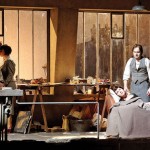
 Opera News have reviewed my latest show:
In his many interviews leading up to the first night of his new production of La Bohème for English National Opera (delayed from Feb. 2 to 4 due to a snowfall that brought the British capital to a virtual standstill), Jonathan Miller complained, not for the first time, of his recent neglect by Britain’s major theater and opera companies. To the latter, in particular, he has given a series of long-term hits. English National Opera’s audiences have been treated to umpteen revivals of his Mikado, Rigoletto and Barber of Seville, and only marginally fewer of his La Traviata and Der Rosenkavalier. At Covent Garden, his Così Fan Tutte has equally become part of the furniture.
The new Bohème certainly made amends by giving Miller another repertory staple to sink his teeth into. His take on the piece, designed by Isabella Bywater, was to move it to the 1930s – the era, Miller noted, of such photographers as Cartier-Bresson, Kertesz and especially Brassaï, referenced in the visuals – and to establish the Bohemian boys’ essential attitudes as similar to those of the struggling young actors in the cult U.K. movie Withnail and I – “shabby, upper-class boys who think squalor is romantic,” as Miller put it.
Miller’s vast breadth of cultural knowledge always gives his productions a sound intellectual basis. What can sometimes tell against them, however, is a surprising disinterest in what actually works effectively in the theater itself. Here, Bywater’s unit set presented the artists’ garret at the top of an apartment block, which opened out and shifted around to make up the street scenes for the Café Momus and Barrière d’Enfer acts. The latter looked marvelous. But the former, a long way from the audience visually and sonically, robbed the crucial intimate exchanges between the characters of a vital connection with the public. The Bohemians’ shenanigans, Mimì and Rodolfo’s love scene and her death, all took place too far away to hit home.
Miller, a doctor by training, has also made the point in the past that dying consumptives apparently do not move much; they just lie there. The Violetta in his ENO Traviata did just that, which may have been medically correct but looked theatrically feeble. So it was with his Mimì on this occasion, sung by American soprano Melody Moore, who lay down and sang and then died, scarcely raising her head in the direction of Alfie Boe’s Rodolfo, before succumbing in the most unostentatious manner possible. But the London Coliseum is a theater, not a hospital ward, and the theatrical potency of the moment disappeared in the theoretical dogma.
Throughout, in fact, the central relationships needed more clarity and focus. In terms of the audience’s engagement with the lives and loves of the artists and their girlfriends, this was a vague and tepid evening. Things looked up in the Café Momus act, where Texas-born Hanan Alattar brought vocal brightness and point to Musetta’s waltz song and a cheeky vitality to her characterization; she was neatly supported by Richard Angas’s flummoxed Alcindoro. Neither David Stout’s Schaunard nor Roland Wood’s Marcello, decently sung and acted as they were, left any strong impression, but Estonian bass-baritone Pauls Putnins gave a considered and memorable account of Colline’s coat aria.
At the center of the evening were Moore and Boe, the latter a crossover artist who is returning more and more to the world of opera, which is his natural home. Both would have been more effective in a more detailed and indeed more visible production. (Jean Kalman’s lighting often obscured matters further.) Miller seemed at pains to de-romanticize their initial encounter and its consequences. Moore certainly has an appealing lyric soprano with some strength and dynamic range to it; her phrases rose and fell in a shapely, sentient fashion. So did Boe’s, though on this occasion his voice sounded small for London’s largest theater. (In his defense, he was too often blocked far upstage.) Yet his acting performance was a lot less concentrated or focused than in an earlier assumption of the role in David McVicar’s Glyndebourne staging.
The star of the evening turned out to be the conductor, Peruvian Miguel Harth-Bedoya, music director of the Fort Worth Symphony, who was making his U.K. opera-house debut. His eye for the subtleties and momentary events of Puccini’s score was as keen as his feeling for its overall shape and range of texture. Everything was clear and moved nicely. He proved a genuine find.
The opera was sung in Amanda Holden’s clear, natural translation, a good percentage of which came across.
GEORGE HALL
this article was originally posted a Opera News: http://www.metoperafamily.org/operanews/review/review.aspx?id=2801